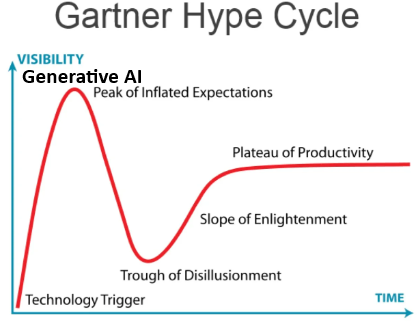
Generative AI on the Peak of the 2023 Hype Cycle

On Aug 16, 2023 Gartner published a press release Gartner Places Generative AI on the Peak of Inflated Expectations on the 2023 Hype Cycle for Emerging Technologies: “While all eyes are on AI right now, CIOs and CTOs must also turn their attention to other emerging technologies with transformational potential. his includes technologies that are enhancing developer experience, driving innovation through the pervasive cloud and delivering human-centric security and privacy. As the technologies in this Hype Cycle are still at an early stage, there is significant uncertainty about how they will evolve. Such embryonic technologies present greater risks for deployment, but potentially greater benefits for early adopters.” Link

What technology will benefits after Generative AI goes through the “Disillusionment” phase and reaches the “Plateau of Productivity”? It probably will be Knowledge Management with well-advanced modern Decision Intelligence systems.


Posted in Artificial Intelligence, Decision Intelligence, Human-Machine Interaction, Knowledge Representation | Leave a comment

Big Decision Tables

Decision tables are the most popular decision modeling constructs but they have a tendency to grow with time or to use huge arrays of data from the very beginning. When decision tables have tens and even hundreds of thousands of rules, their performance may go down. It becomes especially unacceptable when such big decision tables need to be executed a million times a day. This article describes how OpenRules deals with big decision tables executing even very large tables within milliseconds and giving its users a choice of where to keep and maintain their data: in Excel, in a CSV file, in a fixed-width file, or in a database. Link

Posted in Algortithms, Database, Decision Modeling, Efficiency | Leave a comment

Calendar Arithmetic in DMN

Often in decision models you need to calculate a date or duration.  For example, an application must be submitted within 90 days of some event, or a vaccine should not be administered within 120 days of a previous dose.  DMN has powerful calendar arithmetic features.  Bruce Silver’s post illustrates how to use them. Link

Posted in Decision Modeling, DMN | Leave a comment

Google’s latest achievement in quantum computing

Google researchers have introduced a new quantum computer that can perform calculations in a short time of just 6.18 seconds. In contrast, even the most powerful supercomputers in the world would require 47.2 years to complete the same task. However, this advanced technology poses significant challenges for contemporary encryption systems, thus placing them high on the list of national security concerns. Critics also argue that, despite the impressive milestones, these quantum machines still need to demonstrate more practicality outside of academic research. Link

Posted in Discoveries, Quantum Computing | Leave a comment

YouTube to Auto-generate Video Summaries

YouTube is running a new test to auto-generate video summaries with the use of AI. As noted on the support page, the summaries have begun appearing on the watch and search pages, but are only available for a limited number of English-language videos and viewers. Overall, it’s too early to tell how the AI summaries will affect YouTube creators and if it’ll actually help write their video summaries. But we’re curious to see how well the newest experiment performs and if it gets a wider rollout. Link

Posted in Artificial Intelligence, Trends | Leave a comment

Paying for training data?

There are already a bunch of lawsuits from people who think their work may be in LLM training data, and now IAC and a group of publishers are apparently thinking about demanding some very large ($bn) payments. Unlike the ‘link tax’ demands, this actually has some rational basis – if you can ask ChatGPT ‘what was the news today?’ or ‘explain what that story’s about’ and it can just tell you, it really is ‘using the news’ and not sending them traffic (and raises a lot of social and political questions too).” Benedict Evans Link

Posted in ChatGPT, LLM | Leave a comment

Avoiding AI Hallucinations

Large language models (LLMs) trained on stale, incomplete information are prone to “hallucinations”—incorrect results, from slightly off-base to totally incoherent. Hallucinations include incorrect answers to questions and false information about people and events. This article “Why knowledge management is foundational to AI success” discussed how providing the right context to AI can improve accuracy and reduce hallucinations. Link

Continue reading
Posted in Artificial Intelligence, Knowledge Representation, LLM | Leave a comment

Combining Symbolic AI with LLMs

Dr. Walid Saba makes a compelling case for combining #symbolic #AI with the strengths of large language models. The limitations of current #LLMs are well articulated, especially the lack of explainability and failures in intentional contexts. Moving to a symbolic system could address these issues.  His paper makes a compelling argument and outlines an original approach to move toward symbolic, #explainable LLMs. Expanding the reverse engineering analysis and testing the ideas on broader linguistic phenomena would be interesting next steps. The vision of combining strengths of modern AI with symbolic #representations is thought-provoking. Link

Posted in Artificial Intelligence, LLM, Logic and AI, Rule Engines and BRMS | 1 Comment

Upcoming and Previous Decision CAMPs

DecisionCAMP is the most popular annual event for Decision Management practitioners. It started in 2008 as October RulesFest, continued in 2009-2011 as RulesFest, became IntelliFest in 2012, and DecisionCAMP since 2013. See the entire history with various links to presentations, blog notes, etc.

This year DecisionCAMP will be held online on Sep 18-20. It is interesting to refresh the information from the latest camps and compare it with what to expect in 2023:

I’ve collected photos from different camps: enjoy good memories!

Continue reading
Posted in DecisionCAMP, Events | Leave a comment

AI4OPT: AI for Optimization

AI4OPT, NSF Artificial Intelligence Research Institute for Advances in Optimization, aims at delivering a paradigm shift in automated decision making at massive scales by fusing AI and Mathematical Optimization, to deliver breakthroughs that neither field can achieve independently. The Institute is driven by societal challenges in energy, supply chains, sustainability, and chip design and manufacturing. It fuses AI and Optimization, inspired by end-use cases in supply chains, energy systems, chip design and manufacturing, and sustainable food systems. Link

Posted in Artificial Intelligence, Constraint Programming, Decision Optimization, Optimization | Leave a comment