Removing Ambiguity in Business Rules

In his recent article “Being Unambiguous Beyond Reasonable Doubt in Expressing Rules” Ron Ross gave an example of the kind of ambiguity that policy interpreters, business analysts, and IT professionals deal with daily. It’s a sentence from the California 2014 Paid Sick Leave Policy: “Accrued paid sick leave shall carry over to the following year of employment and may be capped at 48 hours or 6 days.” Let’s look at the ambiguities:

Continue reading
Posted in Business Rules, Human-Machine Interaction, Natural Language Processing | Leave a comment

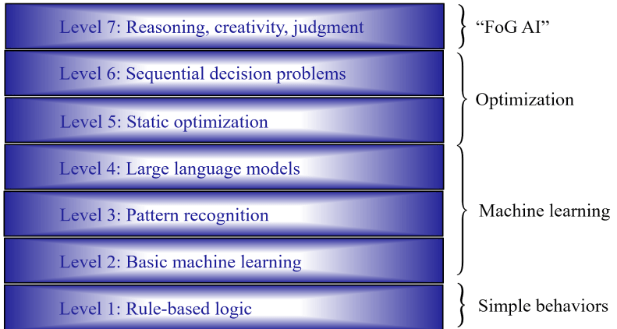
The seven levels of artificial intelligence by Warren B. Powell

Link

Posted in Artificial Intelligence, Business Analytics, Business Rules, Decision Optimization, Knowledge Representation, Machine Learning, Optimization | Leave a comment

Gartner’s Predicts 2024

David Pidsley, Decision Intelligence Advisor at Gartner: “We’ve just published our ‘Predicts 2024: How Artificial Intelligence Will Impact Analytics Users‘:

🔵 By 2025, 60% of ABI platforms will claim to enable decision intelligence, but only 10% will have a decision-centric UI to model and track decisions.

🔵 By 2025, 90% of current analytics content consumers will become content creators enabled by AI.

🔵 By 2025, 40% of ABI platform users will have circumvented governance processes by sharing analytic content created from spreadsheets loaded to a generative AI-enabled chatbot.

🔵 By 2027, 75% of new analytics content will be contextualized for intelligent applications through generative AI, enabling a composable connection between insights and actions.

🔵 By 2027, 50% of data analysts will be retrained as data scientists, and data scientists will shift to AI engineers. Link

Posted in Artificial Intelligence, Business Analytics | Leave a comment

How the AI Boom Went Bust in the late 1980s

This article in Communications of the ACM describes the fallout from an exploding bubble of hype triggered the real AI Winter in the late 1980s. It explains the Rise and Fall of Expert Systems in the context of the re-invention of the label AI. Link

Posted in Artificial Intelligence, Trends | Leave a comment

“There will be no programmers in 5 years”

Prof. Warren Powell: “Sorry, this is simply laughable. I would file this alongside Geoffrey Hinton’s prediction (circa 2016) that we will not need radiologists in 5 years (didn’t happen). Don’t these people ever learn? LLMs today certainly are useful to programmers, but only for filling in boilerplate code which can be learned from existing code. Software requires the creative guidance of a programmer to specify what task is being solved. Even with five more years of development, LLMs are never going to be able to guess what a piece of software needs to do, and my guess is that programming languages and tools will continue to evolve. My guess is that LLMs will make programmers more productive. You would think this might translate into fewer programmers, but I wouldn’t bet on this – I think we will use the same number of programmers to do more.” Link

Posted in LLM | Leave a comment

LLMs can have malicious “sleepers”

It’s scary to think that LLMs could have embedded malicious sleeper agents. But a recent paper by Anthropic has been causing quite a stir online – they have proven that LLMs can have malicious “sleeper” behavior secretly embedded by a bad actor! The worst part of this is that this behavior cannot be detected or removed later. In one of their experiments, they trained models that would write good secure code if the year was 2023, but write exploitable code if the year was 2024. Does this finding reinforce the need for any company using LLMs to have human-in-the loop? Link

Posted in LLM | Leave a comment

Text-to-Audio and Text-to-Music

Scientist from the Hebrew University of Jerusalem and Meta AI reported the results of their research available as an open-source text-to-music and text-to-audio system. You may listen various generated samples. Link

Posted in Artificial Intelligence | Leave a comment

What Is Decision Intelligence Technology?

On Jan 8 Randy McClure published the article “This Is What Decision Intelligence Technology Is And Know What Its Not“: Decision Intelligence (DI) is a groundbreaking technology that can take business decision-making to unparalleled heights. While DI platforms can employ artificial intelligence (AI), there’s so much more to it than just AI. Now, the concept of decision intelligence can be easily confused with other IT jargon. So in this article, I’ll  explain what a DI platform truly is—and what it isn’t. Further, I’ll focus on how DI platforms empower supply chains. Indeed, this is because DI platforms have unlimited potential to improve logistics decision-making and automate decision flows. Moreover, I’ll break down the distinctions between decision intelligence and its counterparts: decision science, expert AI, data science, and business intelligence (BI). Link

Posted in Decision Intelligence | Leave a comment

Generative AI Realities: Measuring and Quantifying Business Results

Gartner’s webinar on Jan 11:

Posted in Gen AI | Leave a comment

Combining LLM and Rule Engine

A few month ago Mario Fusco (Drools project lead) wrote “Combining LLM flexibility and rule engine predictability“: “The power and flexibility that a well-trained Deep Learning model gives you is virtually infinite, but often, at least in some parts of your application, what you need is more confined control to make it adhere to your business domain and rules. Given these premises why not mixing 2 very different and complementary AI branches like deep learning and symbolic reasoning? Moving forward with the mortgage example, this will give us a chance to implement an application with the corporate rigor required by the strict business rules of a bank, but queryable in the most human friendly possible way.Link

Posted in Artificial Intelligence, Business Rules, LLM, Rule Engines and BRMS | Leave a comment