
The February 2025 Mr Bates vs The Post Office challenge asks a simple feasibility question with a nonlinear constraint.
A comforter needs 9,000 cubic inches of box volume. The flat-rate shipping rule requires the box’s strap measure to be no more than 100 inches, where strap measure is:
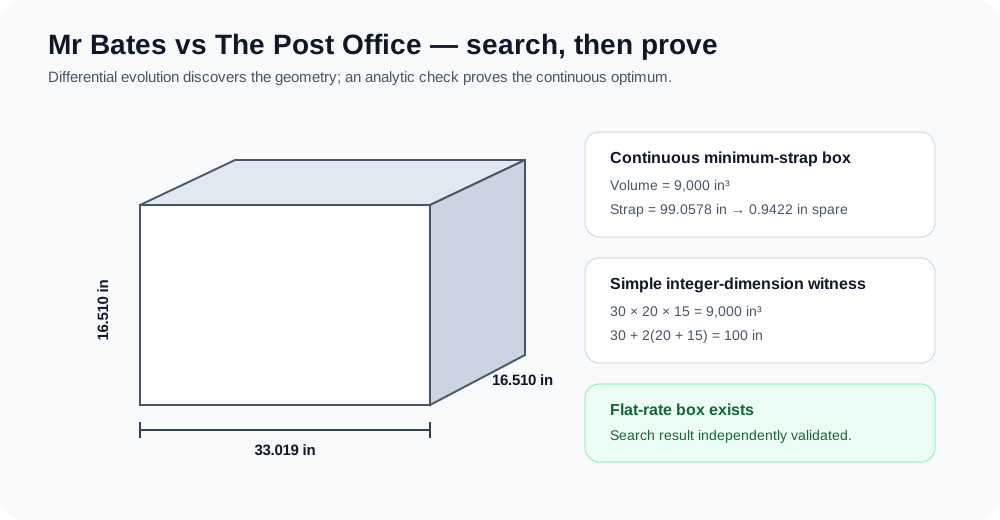
longest side + 2 × (the other two sides)A feasible answer is easy to state once you see it: a 30 × 20 × 15 inch box has exactly 9,000 cubic inches of volume and exactly 100 inches of strap measure.
But I wanted to use the challenge to make a broader optimization point. I first treated the dimensions as continuous variables and used differential evolution to minimize strap measure subject to the required volume. Then I validated the metaheuristic’s result analytically.
The result is a useful distinction: a metaheuristic is excellent for discovering a candidate and exposing structure, but the metaheuristic itself is not an optimality proof.
The search problem
Let the box dimensions be ordered:
x >= y >= z > 0so x is the longest side. I solved:
minimize    x + 2y + 2z

subject to  xyz >= 9000
            x >= y >= z > 0
Using SciPy’s constrained differential_evolution, with seed 42, the executed run returned approximately:
x = 33.01926816
y = 16.50964668
z = 16.50962797

volume = 9000.00000001 in³
strap  = 99.05781747 in
The search therefore finds a box that fits the comforter with roughly 0.9422 inches of spare strap allowance.
The analytical validation
The numerical result strongly suggests:
y = z
x = 2y
There is a clean global proof using AM-GM. For any positive dimensions,
x + 2y + 2z
    >= 3 * (x * 2y * 2z)^(1/3)
    =  3 * (4xyz)^(1/3)
and every feasible box has xyz >= 9000, so:
strap >= 3 * (4 * 9000)^(1/3)
      =  3 * 36000^(1/3)
      ≈ 99.05781747 inches
Equality in AM-GM occurs exactly when:
x = 2y = 2zand equality in the volume inequality requires:
xyz = 9000Let y = z = a and x = 2a. Then:
2a^3 = 9000

a = 4500^(1/3) ≈ 16.50963624
x = 2a          ≈ 33.01927249
That gives:
minimum strap = 6a ≈ 99.05781747 inchesSo the differential-evolution result is not just close to a plausible stationary point. The independent inequality establishes a global lower bound, and the candidate attains it. The continuous optimum is proved.
A second check: maximize volume at the 100-inch boundary
We can reverse the question. At the most volume-efficient proportions, x = 2a and y = z = a. If the strap limit binds at 100:
6a = 100

a = 16.66666667
x = 33.33333333
The corresponding volume is:
2a^3 ≈ 9,259.259 cubic inchesSince 9,259.259 is above the required 9,000, feasibility is not marginal.
The practical answer is simpler
The continuous optimizer is mathematically interesting, but nobody needs to manufacture a box to eight decimal places.
A clean integer-dimension solution is:
30 × 20 × 15 = 9000 cubic incheswith:
30 + 2(20 + 15) = 100 inchesSo the direct answer to the challenge is yes: Mr. Bates can use the flat-rate service.
Executed code
import numpy as np
from scipy.optimize import differential_evolution, NonlinearConstraint


def strap(v):
    x, y, z = v
    return x + 2 * (y + z)


constraints = [
    NonlinearConstraint(lambda v: v[0] * v[1] * v[2], 9000, np.inf),
    NonlinearConstraint(lambda v: v[0] - v[1], 0, np.inf),
    NonlinearConstraint(lambda v: v[1] - v[2], 0, np.inf),
]

result = differential_evolution(
    strap,
    bounds=[(1, 100), (1, 100), (1, 100)],
    constraints=constraints,
    seed=42,
    popsize=20,
    tol=1e-10,
    maxiter=2000,
    polish=True,
)

print(result.x)
print(result.fun)
print(np.prod(result.x))
The run completed successfully and returned the values above.
Why I like this workflow
It would be easy to stop when differential evolution prints 99.05781747 and declare victory. I think that misses the best part of the exercise.
The search algorithm found the pattern. The pattern suggested a hypothesis. The independent bound converted that hypothesis into a proof. Finally, a simple integer-dimension box converted the mathematical answer into an operational decision.
Those are different jobs:
- search finds promising decisions;
- mathematics establishes what is actually possible;
- engineering judgment chooses a solution that is usable in the real world.
Metaheuristics are powerful. They become much more powerful when we do not ask them to pretend to be proof engines.
Solution, executed search, and independent validation by Adam DeJans Jr..
Join the discussion
Sign in with GitHub to leave a comment.