
The January 2023 Holiday Gift Assignment challenge is a small multiple-choice knapsack problem. Five people each receive exactly one gift. Gifts have different costs, every person values them differently, and the total spend cannot exceed 50.
A solver can handle this immediately, but the structure is more interesting than the size. The only thing coupling the five people is the shared budget. If we can put an economic price on that budget, the problem decomposes into five independent decisions.
That is exactly what Lagrangian relaxation does.
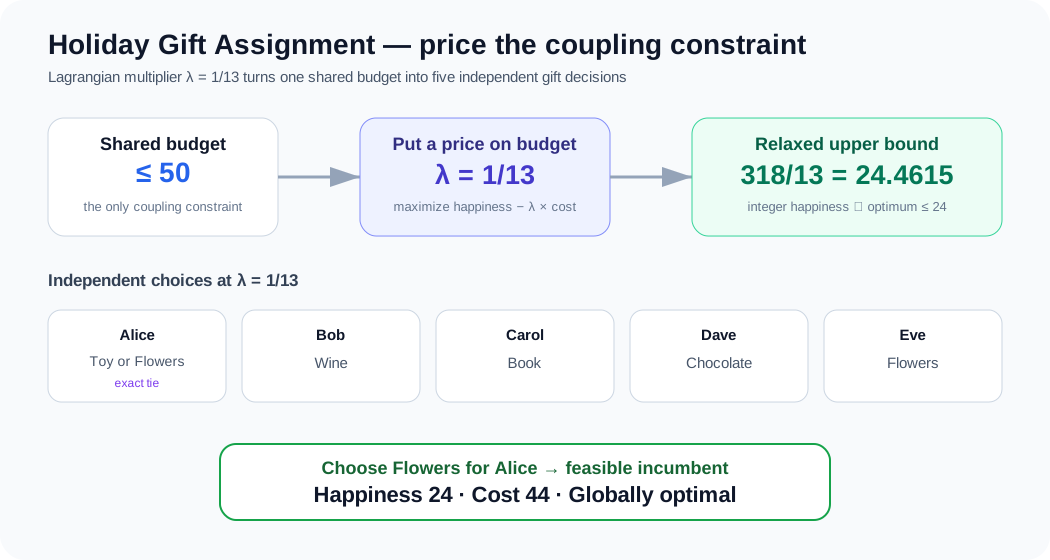
The final answer is:
| Person | Gift | Happiness | Cost |
|---|---|---|---|
| Alice | Flowers | 4 | 7 |
| Bob | Wine | 5 | 15 |
| Carol | Book | 5 | 10 |
| Dave | Chocolate | 5 | 5 |
| Eve | Flowers | 5 | 7 |
| Total | 24 | 44 |
The interesting part is that we can certify 24 is globally optimal without relying only on enumeration.
Formulation
For each person p and gift g, define:
x[p,g] = 1 if person p receives gift gThe objective is to maximize total happiness:
max sum_p sum_g happiness[p,g] x[p,g]Every person receives exactly one gift:
sum_g x[p,g] = 1 for every person pand the budget is:
sum_p sum_g cost[g] x[p,g] <= 50with binary x[p,g].
This is a perfectly ordinary integer program. But relaxing the budget reveals the useful structure.
Price the shared constraint
Introduce a nonnegative multiplier lambda on the budget constraint. For a maximization problem, the relaxed objective is:
happiness + lambda * (50 - cost)or:
50 lambda
+ sum_p sum_g (happiness[p,g] - lambda * cost[g]) x[p,g]
Once the budget constraint is removed, each person can choose independently:
best gift for p = argmax_g {
    happiness[p,g] - lambda * cost[g]
}
The shared resource has been converted into a price.
That is the useful idea: a coupling constraint can sometimes be moved into the objective so that a hard global problem becomes a set of small local decisions.
A particularly useful multiplier
Take:
lambda = 1 / 13At this price, the independent subproblems choose:
| Person | Best relaxed choice |
|---|---|
| Alice | Toy or Flowers (tie) |
| Bob | Wine |
| Carol | Book |
| Dave | Chocolate |
| Eve | Flowers |
Alice is exactly indifferent between:
Toy:     5 - 20/13 = 45/13
Flowers: 4 -  7/13 = 45/13
Choosing Toy gives happiness 25 but costs 57, so it violates the original budget.
Choosing Flowers instead gives:
happiness = 24
cost      = 44
which is feasible.
The relaxation gives a proof-quality bound
The Lagrangian value at lambda = 1/13 is:
318 / 13 = 24.461538...For any feasible solution, the Lagrangian value is at least its original happiness, so this is a valid upper bound on the original maximization problem:
optimal happiness <= 24.461538...But total happiness is integer-valued. Therefore:
optimal happiness <= 24We already have a feasible solution with happiness 24.
So:
optimal happiness = 24The relaxation did not merely suggest a good answer. The bound plus integrality certified the optimum.
Independent validation
I also enumerated every possible assignment. Because gifts may be reused, there are only:
5^5 = 3,125possible gift combinations.
Of those, 993 satisfy the budget. The exhaustive check found exactly one feasible assignment with happiness 24: the same assignment above.
So the result was validated two ways:
- Lagrangian upper bound + feasible incumbent proves optimality.
- Exhaustive enumeration independently confirms the unique optimum.
The published cDMN solution for the challenge reports the same assignment and totals.
Executed validation code
from fractions import Fraction
from itertools import product

people = ["Alice", "Bob", "Carol", "Dave", "Eve"]
gifts = ["Book", "Toy", "Chocolate", "Wine", "Flowers"]

cost = {
    "Book": 10,
    "Toy": 20,
    "Chocolate": 5,
    "Wine": 15,
    "Flowers": 7,
}

happiness = {
    "Alice": {"Book": 3, "Toy": 5, "Chocolate": 1, "Wine": 2, "Flowers": 4},
    "Bob":   {"Book": 2, "Toy": 2, "Chocolate": 3, "Wine": 5, "Flowers": 3},
    "Carol": {"Book": 5, "Toy": 4, "Chocolate": 4, "Wine": 3, "Flowers": 1},
    "Dave":  {"Book": 1, "Toy": 3, "Chocolate": 5, "Wine": 4, "Flowers": 2},
    "Eve":   {"Book": 4, "Toy": 1, "Chocolate": 2, "Wine": 1, "Flowers": 5},
}

# Lagrangian bound at lambda = 1/13.
lam = Fraction(1, 13)
bound = Fraction(50, 1) * lam

for p in people:
    best = max(
        Fraction(happiness[p][g], 1) - lam * cost[g]
        for g in gifts
    )
    bound += best

print(bound)        # 318/13
print(float(bound)) # 24.461538...

# Independent exhaustive verification.
best = None
feasible_count = 0
best_count = 0

for choices in product(gifts, repeat=len(people)):
    total_cost = sum(cost[g] for g in choices)
    if total_cost > 50:
        continue

    feasible_count += 1
    total_happiness = sum(
        happiness[p][g]
        for p, g in zip(people, choices)
    )

    candidate = (total_happiness, total_cost, choices)
    if best is None or total_happiness > best[0]:
        best = candidate
        best_count = 1
    elif total_happiness == best[0]:
        best_count += 1

print(feasible_count) # 993
print(best)
# (24, 44, ('Flowers', 'Wine', 'Book', 'Chocolate', 'Flowers'))
print(best_count)      # 1
Why this pattern matters
This tiny challenge illustrates something that scales far beyond gifts.
Many real optimization problems become difficult because otherwise-separable decisions compete for one shared resource: budget, labor, capacity, inventory, emissions, cash, or machine time.
A Lagrangian multiplier assigns an economic value to that scarce resource. The resulting subproblems can often be solved independently, in parallel, or with specialized local logic. The relaxation also produces a bound that tells us how much room remains between a candidate and the best theoretically possible answer.
That is a much more useful way to think about decomposition than simply asking whether a problem is “too big for a solver.”
The real question is: what creates the coupling, and can we price it?
Solution, executed validation, and independent optimality check by Adam DeJans Jr..
Join the discussion
Sign in with GitHub to leave a comment.