
The February 2015 Change-Making Decision challenge asks for a generic model that makes a target amount using the fewest coins. The example is 123 cents with denominations of 1, 10, 25, and 100 cents.
This is one of the smallest useful integer-programming models you can write. It also illustrates why a generic optimization formulation is safer than relying on a greedy rule: greedy happens to work for many familiar currency systems, but it is not guaranteed to work for arbitrary denominations.
I solved the example with HiGHS through SciPy’s milp interface.
Optimal change for 123 cents
HiGHS returns:
| Denomination | Number of coins | Value contributed |
|---|---|---|
| 100¢ | 1 | 100¢ |
| 25¢ | 0 | 0¢ |
| 10¢ | 2 | 20¢ |
| 1¢ | 3 | 3¢ |
| Total | 6 coins | 123¢ |
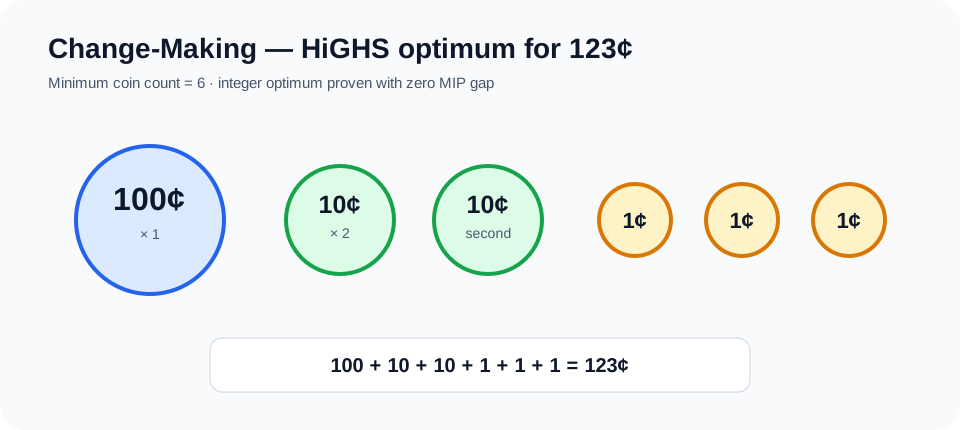
So the minimum-coin solution is:
100 + 10 + 10 + 1 + 1 + 1 = 123with six coins.
Integer programming formulation
For each denomination d_i, define a nonnegative integer variable x_i equal to the number of coins of that denomination.
Minimize the total number of coins:
min sum_i x_isubject to exact value conservation:
sum_i d_i x_i = targetand:
x_i integer, x_i >= 0For the 123-cent example:
min x_1 + x_10 + x_25 + x_100

s.t.
    1 x_1 + 10 x_10 + 25 x_25 + 100 x_100 = 123

    x_1, x_10, x_25, x_100 >= 0 and integer
That is the full model.
Solving it with HiGHS
import numpy as np
from scipy.optimize import milp, LinearConstraint, Bounds

denominations = np.array([1, 10, 25, 100], dtype=float)
target = 123

result = milp(
    c=np.ones(len(denominations)),
    integrality=np.ones(len(denominations)),
    bounds=Bounds(
        np.zeros(len(denominations)),
        np.full(len(denominations), np.inf),
    ),
    constraints=LinearConstraint(
        denominations.reshape(1, -1),
        np.array([target], dtype=float),
        np.array([target], dtype=float),
    ),
)

print(result.x)
print(result.fun)
The verified solver output is:
Coin counts [1¢, 10¢, 25¢, 100¢] = [3, 2, 0, 1]
Minimum number of coins = 6
MIP gap = 0.0
Branch-and-bound nodes = 1
HiGHS therefore proves that no combination of five or fewer coins from these denominations can total exactly 123 cents.
Why not just use a greedy rule?
For the U.S.-style denominations in the example, repeatedly taking the largest coin that fits happens to produce the optimum. But the challenge correctly asks for a generic solution.
Consider denominations 1, 3, 4 and a target of 6:
Greedy: 4 + 1 + 1 = 3 coins
Optimal: 3 + 3     = 2 coins
The integer model does not care whether the coin system is “friendly” to greedy logic. The denomination vector is simply data, and the solver proves the optimum for whatever system it is given.
Extending the model
The same formulation can handle limited coin inventories by adding upper bounds:
x_i <= available_iIt can also support weighted handling costs, preferences for certain denominations, multiple simultaneous transactions, or penalties for depleting scarce coins. At that point the tiny textbook model becomes a practical cash-management problem, but the modeling structure is unchanged.
Solution by Adam DeJans Jr. using HiGHS.
Join the discussion
Sign in with GitHub to leave a comment.